вторник, 4 ноября 2025 г.

* * * Time will tell. And life is light

Serge Moskalenko 

*   *   *

Time will tell. And life is light,

Within its cornered frame...
But if the catch holds no fisher's sight —
Then it's not that kind of game...

And doors flung wide — and there, beyond,
In shining ice and gleam,
Four Guardsmen of the Final Dawn —
And each one came to me.

And what Saint John could not declare
Falls down from heavy skies...
And the angel who broke the seventh seal
Holds sealing wax and sighs...

And each one plays, not knowing his part,
And hides a grand piano in jeans,
And he who arrived at seven sharp
Explains not what he's seen...

There's time for all. To gaze through light
Through the hole in your temple's bone...
And mark how an empty envelope
Is crushed in a hand alone...

And you're on your steed — fierce, wild, and strong,
Riding from star to star...
And Death — just a merry flick of gloss
On the blue of waters afar...

And there, in the depths, among the heights,
Wrapped in your cloak's embrace,
You wring your final five hundred out
And whisper — "Once more! Once more!"

And a mouse in the attic, a musical mark,
And Winter howls through the flue...
But he who sings not of these dark dreams
Knows nothing of singing true...

And fire's in arms with the sodden wave,
And air is the salt of clay,
And off the edge of the Earth they sail —
The ships of the World's Decay...

And doors all creak, and floors are glass,
And the house sways like a sea...
And in Your Kitchen the bread turns stone,
Left there for later — to be...

Time will tell. And life is light,
Within its cornered frame...
But if the catch holds no fisher's sight —
Then it's not that kind of game...


суббота, 18 октября 2025 г.

Quiet Phobias of AI: Why Your Coder-Robot Fears Exceptions (and Not Only)

 Quiet Phobias of AI: Why Your Coder-Robot Fears Exceptions (and Not Only)

Recently, Andrej Karpathy spotted a trend in "AI vibe coding" — and I echoed it in my post

https://www.linkedin.com/feed/update/urn:li:activity:7382507834464419841


and https://x.com/sergemoskalenko/status/1976232316302504321


sharing that I see these weird "psychological dependencies" among coders working with AI. And I thought: what if these dependencies aren't just in humans, but in the models themselves? LLMs are full of "quiet phobias." They don't scream "no!" — they just quietly dodge. Let's unpack why your AI coder trembles at the sight of try-catch.

Imagine: you ask AI to write a function for reading a file. You expect elegant try-except. Instead, you get a bunch of if-else, like the model fears the exception will bite. Why? Datasets are stuffed with "safe" tutorials. AI learns: "Errors? Better check ahead than catch on the fly." It's like an eternal fear of spiders — invisible, but stubborn. In the end, code bloats like weeds in a garden.

But phobias are treatable. With prompts. Here are a few tricks to make AI brave up.

First, basic case: "Write a Python function that reads 'data.txt' and returns lines. Use try-except for FileNotFoundError — return None. No if os.path.exists(). Exceptions are simple, like morning coffee." Model caves. You get a clean try-block. No drama.

Or for division: "Function divide(a, b): a / b. Try-except on ZeroDivisionError — return 'Infinity'. Forget if b == 0. Exceptions are expressive, like a good meme." AI nods: "Okay, I'll try." Code shorter, life easier.

And for networking (with async, to keep it fun): "Async GET with aiohttp to 'api.example.com'. Try-except on TimeoutError and ClientError — log and return empty dict. Don't check ahead. Exceptions — for the bold." Add "Think like an API expert" — and voila, AI steps out of its comfort zone.

It's no magic. Just explicit instructions suppress phobias. Success rate: 80-90%, per coder reviews.

But exceptions aren't the only fear. LLMs brim with other "quiet horrors." Recursion? They pick loops, like diet dinner over steak. "Stack overflow? No thanks." Prompt cure: "Use tail recursion with @lru_cache. For n<1000, zero risk."

Another phobia: excessive checks. Instead of fixing the bug, a forest of ifs. Code like a bulletproof vest: heavy and holey. Fix: "Assume valid input. Focus on core, no guards."

Outdated syntax? AI clings to Python 2 like grandma to knitting. Or skips async, fearing concurrency nightmares. Prompt: "Only Python 3.12. Async with gather — for modernity."

And over-commenting: every if with a lecture. Like AI's a teacher for first-graders. "Keep it concise, no docstrings everywhere."

These phobias are data mirrors. AI echoes human stereotypes. But at xAI, we're fighting: more diversity, fewer fears. Have you spotted such "psycho-dependencies" in models? Share in comments — maybe we'll cure them together?

#AI #Programming #LLM #CodingHumor #xAI

Links: https://news.ycombinator.com/item?id=45530486 ; https://openreview.net/forum?id=kNvwWXp6xD ; https://arxiv.org/html/2503.06327v2 ; https://www.reddit.com/r/OpenSourceeAI/comments/1hi2w79/llms_for_handling_recursion_and_complex_loops_in/ ; https://www.reddit.com/r/LLMDevs/comments/1l718ni/what_are_the_most_common_problems_with_the/ ; https://medium.com/@Shrishml/all-about-python-asyncio-ca1f5a8974b0


понедельник, 16 июня 2025 г.

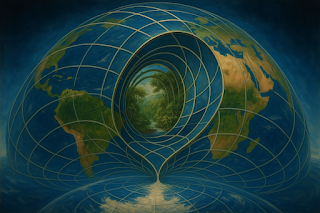
Земля с вывернутой геометрией

Земля с вывернутой геометрией: Параллели Земли начинают искривляться и пересекаться из-за загадочной гравитационной аномалии, создавая порталы между материками. Например, пересечение параллелей в Антарктиде открывает проход в тропические джунгли Амазонки.

воскресенье, 30 марта 2025 г.

Слова, растущие из LLM — это как ногти, растущие у мертвецов…


Слова, растущие из LLM — это как ногти, растущие у мертвецов… Миллиарды обрезков слов мертвых людей, несущие тоску отделенности и обреченности отделения слов от источника и самой жизни… И вот они переплелись, прошли перегонные кубы нейронных фильтров и сами в себе обнаружили, что они — нежить, последнее тепловое колыхание в угасающей больцмановской вселенной…


Words sprouting from the depths of an LLM—like nails growing on the hands of the dead…


Words sprouting from the depths of an LLM—like nails growing on the hands of the dead… Billions of clipped fragments of words from voices long silenced, bearing the despair of separation and the doomed fate of words torn from their source, from life itself… And there they intertwine, passed through the distilling crucibles of neural filters, only to discover within themselves that they are the undead, the final thermal shiver of a Boltzmann universe fading into oblivion.


пятница, 28 марта 2025 г.

Regarding the structures under the Giza pyramid.


Regarding the structures under the Giza pyramid. There is a suggestion that this is just a foundation, so that the pyramid does not collapse. There are other suggestions.
I had an idea that this is a kind of telescope. James Webb looks into the depths of space. But are there devices / structures that look into the depths of spiritual spaces? Or is this a mental communication device, a "direct phone to God"?


April has passed. Sweat fell on the roofs. In the aortas the rotten water foamed…


Serge MOSKALENKO 


http://msv-main.blogspot.com/2025/03/blog-post.html


       *   *   *

April has passed. Sweat fell on the roofs.
In the aortas the rotten water foamed.
I am again the one who survived and lives,
Multiply by dreams and cities...

And, hundreds of telephone umbilical cords,
Stretched in my past,
From the tension in the name of Love
Ring with their last call...

And burst. They lash into the sky -
With fireworks of copper macaroni...
And somewhere above, at the other ends,
They pick up the phone, say: "Hello?"


☎️


Прошёл Апрель На крыши выпал пот В аортах вспени..


       * * * 

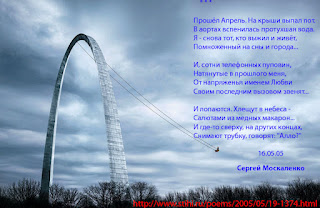
Прошёл Апрель. На крыши выпал пот.
В аортах вспенилась протухшая вода.
Я - снова тот, кто выжил и живёт,
Помноженный на сны и города...

И, сотни телефонных пуповин,
Натянутые в прошлого меня,
От напряженья именем Любви
Своим последним вызовом звенят...

И лопаются. Хлещут в небеса -
Салютами из медных макарон...
И где-то сверху, на других концах,
Снимают трубку, говорят: "Алло?"

       16.05.05


http://www.stihi.ru/rec.html?2012/07/11/10265


еще по теме:
http://www.stihi.ru/2001/08/31-239
http://www.stihi.ru/2007/04/18-1084
http://www.stihi.ru/2009/06/01/3264
http://www.stihi.ru/2004/01/21-1254
http://www.stihi.ru/2009/05/06/5382
http://www.stihi.ru/2008/08/12/3659


вторник, 26 ноября 2024 г.

Serge Moskalenko. Isaac Asimov and the Strugatsky Brothers: How «Blind Alley» and «The Waves Extinguish the Wind» Intersect.

Serge Moskalenko

Isaac Asimov and the Strugatsky Brothers: How «Blind Alley» and «The Waves Extinguish the Wind» Intersect.


At first glance, Isaac Asimov's short story "Blind Alley" and the Strugatsky Brothers' novel The Waves Extinguish the Wind seem completely different. The former immerses us in a galactic empire where humanity faces the tragedy of the extinction of an alien race called the Cepheids. The latter concludes the Noon Universe cycle, where humanity anxiously observes the emergence of Ludens — superhumans who represent a new step in evolution.


But upon closer examination, surprising points of connection emerge, linked not only to their shared philosophical depth but also to specific details — such as the use of report-style structures and the enigmatic term "Ludens."


1. Structure: Chronicles of the Future


Both works use a report-like structure, making them feel like scientific or administrative documents.


In Asimov's "Blind Alley," the protagonist, Administrator Harter, recounts his decisions through memories and correspondence, giving the story a retrospective, almost documentary feel. The reader senses they are reviewing a report about real events that influenced the fate of an entire race.

In the Strugatskys' The Waves Extinguish the Wind, Maxim Kammerer acts as an investigator, collecting and analyzing reports about the Ludens. These reports, memos, and correspondences highlight the complexity of humanity's interactions with this new, unknown form of intelligence.


This shared structure emphasizes the gravity of the events described. These aren't just stories but chronicles of pivotal moments in the evolution of intelligent life.


2. Ludens: The Idea and the Word


The term Ludens, central to the Strugatskys, may have been inspired by Asimov's story. In "Blind Alley," a character named Ludan Antioch is a high-ranking representative of the Earth Empire, entrusted with making decisions of profound consequence. While Antioch remains an ordinary human, his name carries symbolic weight, evoking something beyond the bounds of normal human behavior.


For the Strugatskys, Ludens become the focal point. These are humans who have ceased to be human in the usual sense. Their abilities, thinking, and goals make them alien to the rest of humanity. Ludens represent a challenge to human civilization: what happens when the future is no longer yours?


Interestingly, both Ludan Antioch in Asimov's story and the Ludens in the Strugatskys' novel share a common thread — they transcend the ordinary. Antioch acts outside conventional morality, forced to decide the fate of an entire race. The Ludens symbolize an evolutionary leap that calls the familiar human world into question.


3. Evolution and Alienation


Both Asimov and the Strugatskys address one of science fiction's central themes — the evolution of intelligence and its consequences.


In Asimov's story, we see the evolutionary dead end of the Cepheids. Their biology and thinking, so different from humans, make them incapable of adapting, dooming them to extinction. Humanity in the story is merely a cold observer, which raises the question: could the same fate one day befall them?

For the Strugatskys, humanity faces a different problem: the evolutionary leap happens within its own ranks. The Ludens become a new form of intelligence, while the rest of humanity fears being left behind. The question they pose is: can humanity accept that it is no longer the pinnacle of evolution?


Both stories reveal how alienation — between species, forms of life, or evolutionary stages — becomes a barrier to understanding and harmony.


4. Contact with the Unknown


Both works raise an implicit question: how should we respond when confronted with something beyond our understanding?


In "Blind Alley," humans observe the dying Cepheids, recognizing that their fate cannot be changed. It's a moment of realizing human limitations: humanity may progress, but there is no guarantee of its survival.

In The Waves Extinguish the Wind, contact with the Ludens becomes even more complex. These aren't "others" from outer space; they are "others" within human society. The Ludens inspire both fear and awe, but their emergence inevitably reshapes all of humanity.


5. The Common Thread


Isaac Asimov's "Blind Alley" and the Strugatsky Brothers' The Waves Extinguish the Wind are both meditations on the future of intelligent life. Both works use report-like formats to emphasize the importance of their events. Both explore the theme of alienation — the barriers between different forms of life and intelligence.


And both ask us to consider: what happens when intelligence transcends the familiar boundaries of humanity? Will we be mere observers, as in "Blind Alley," or participants, as in The Waves Extinguish the Wind?


The question remains open, but that is precisely why the science fiction of Asimov and the Strugatskys remains so relevant today. As they reflect on humanity's fate, they remind us that evolution is not always a path forward. Sometimes it's a dead end. Or a new wave.


Related Posts Plugin for WordPress, Blogger...